A basic (starter) wavetable editor.
jakepenn_ wrote on the Discord channel:
-Wavetable editor is cool but it’s also a very large and opaque thing to request.
I think we should start with something simple. And just gradually develop it over time.
If I were a developer, I’d consider starting the initial build of the editor with the most frequently used functions, namely:
A harmonic editor — one of the most frequently used features by me and others. It provides the ability to fine-tune the fundamental harmonic as well as its neighboring ones, allowing for very precise control over low frequencies. The ability to remove frequencies that may cause aliasing when applying saturation/distortion. Or to redraw the timbre using a harmonic spectrum analyzer. For this level of editing, simple built-in wave warping modes could be created - such as high-pass and low-pass filters - which smoothly adjust harmonics based on filter principles. And also add a basic harmonic phase control function.
A window for drawing waveforms - similar to the one in Kilohearts' editor.
With automatic transitions between frames. And with drawing tools like: pen, pencil, and basic shapes such as sine, square, triangle. With the ability to place everything using a customizable grid snap. The pen should be able to draw shapes with sharp corners (e.g., with a regular left mouse click). Or with smoothed curves, similar to how it's done in Photoshop - when holding the left mouse button and dragging, enabling a smoothing function with adjustable angle slopes extending from the point:
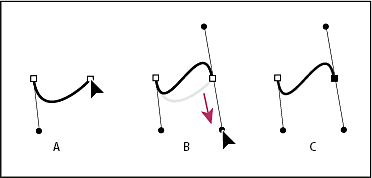
Points could be deleted by double-clicking the left mouse button.
Last but not least - the ability to adapt samples into wavetables.
This is exactly why everyone wants a wavetable editor and what gets used incredibly often.
We need the ability to properly match a sample to the capabilities of a wavetable oscillator so it can be played back without artifacts. We need correction tools for this task. Some functions that smooth frames, distribute them along the sample length, normalize, etc. And thus, it would be possible to turn samples into wavetables themselves.
These functions will already be enough for us to start creating interesting wavetables and designing sounds at a deeper level. In any case, some initial editor is needed, through which a further development roadmap can then be outlined. Because to find solutions and innovations, you need to encounter problems - meaning there must be an object of interaction, which currently doesn’t exist. A basic wavetable editor would help move in the direction discussed by jakepenn_:
Honing in more on what you specifically want to do with a wavetable editor and the assessing if a wavetable editor is the best way to achieve that is an important thing to consider.
Using it will provide insight into its flaws, strengths, what can be improved, and what can be added.
Log in to comment and vote
Comments2
User
Mar 30, 2025
i’m also looking forward to this! for me one of the most useful and interesting things would be:
1. adding harmonics and basic shapes + noise
2. having processing to add some of the warp effects from current to those WT
3. it being capable of reproduce sound and morph while you are testing the wavetable, so you can just play a note while tweaking and hear changes in real time
User
Mar 30, 2025
The third point sounds awesome! That's a great idea. As for the second point, I mentioned it earlier. But I just suggested starting with something simple, like frequency filters. Still, you're absolutely right—the ability to statically apply warping modes in the editor before processing the waves in the oscillator settings would free up the oscillator's warping from basic tasks that often waste a slot needed for dynamic wave modulation. I was thinking the same thing.